
Skip to main navigation menu Skip to main content Skip to site footer

Volume 2, No. 01DSJEM

Published June 21, 2026

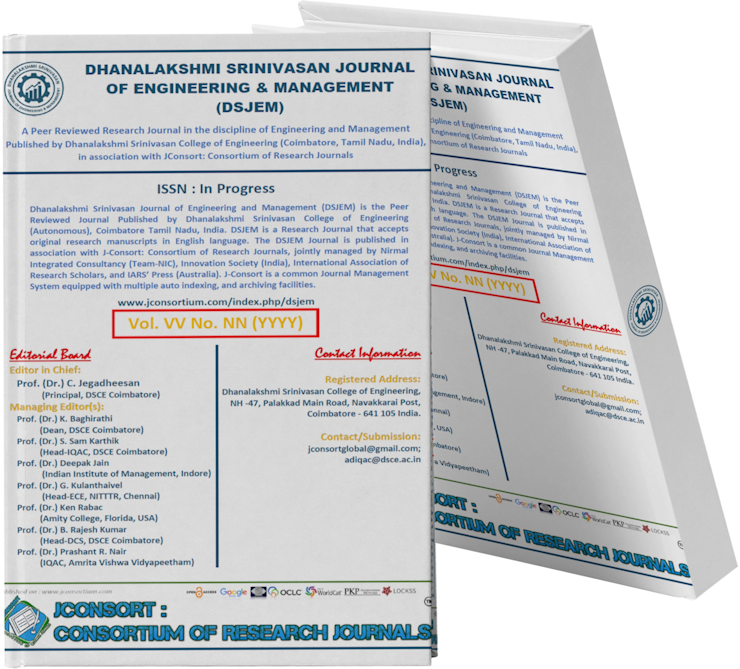
DSJEM Hardbound

Issue description

Dhanalakshmi Srinivasan Journal of Engineering and Management (DSJEM)
Volume 2, Number 01 (2026)

This issue of the Dhanalakshmi Srinivasan Journal of Engineering and Management (DSJEM) presents a collection of peer-reviewed research articles highlighting recent advancements in engineering, technology, management, artificial intelligence, sustainable development, and agricultural innovation. This issue showcases interdisciplinary research addressing contemporary challenges through innovative technological solutions.

The published papers explore diverse themes including generative AI for structural design optimization and cost reduction, AI-assisted technologies for the visually impaired, smart surveillance and disaster management using AI-integrated drones, robotic artificial intelligence, metaverse applications powered by virtual humans, and AI-based optimization in construction materials. Significant contributions in sustainable agriculture are presented through studies on aeroponics, hydroponics, precision farming, IoT-enabled seed metering systems, paddy drying technologies, and wildlife-human conflict mitigation using intelligent sensing systems.

The issue also emphasizes sustainable development through research on hybrid renewable energy systems, 3D printing technologies in construction, advanced metal matrix composites, and the role of social media in service marketing within the hospitality sector. Collectively, these articles provide valuable insights for researchers, academicians, industry professionals, and policymakers seeking innovative approaches to engineering excellence, environmental sustainability, and digital transformation.

This volume reflects DSJEM's commitment to promoting high-quality scholarly research and fostering the exchange of knowledge across emerging domains of science, engineering, technology, and management.

Peer Reviewed Article

  1. Structural Design Optimization and Cost Reduction Using Generative Artificial Intelligence Models

    In recent years, the rise of generative artificial intelligence (AI) has opened up exciting new possibilities for the field of structural engineering. This technology is helping engineers create more efficient and cost-effective designs. In this paper, we explore how generative AI models can be applied to structural design, focusing on improving performance while also cutting costs. We present a carefully crafted framework that blends AI-generated design with traditional engineering analysis. This ensures that all designs meet safety standards and fulfill functional requirements.
    Through a series of case studies on different structural systems, we demonstrate AI's impressive ability to innovate design configurations, use less material, and reduce construction expenses—all without compromising the strength and safety of the structures. Our findings show that generative AI has the potential to speed up the engineering design process, encourage creativity, and usher in a new era of sustainable and affordable building practices. This research marks an important step toward making AI-driven optimization a regular part of structural engineering.

  2. AI Based Aid with Integrated Reading for Completely Blind

    This document presents the development of an assistive technology tool designed to enhance environmental awareness and information accessibility for visually impaired individuals using AI-based features. The system integrates a hands-free camera with advanced deep learning algorithms to enable real-time object detection, scene understanding, face recognition, and text recognition within the user’s immediate surroundings. It also incorporates GPS functionality for location tracking.
    Identified objects and extracted text are conveyed through multimodal feedback, including synthesized speech and tactile cues, providing a more comprehensive understanding of the environment. Additionally, the system includes an Optical Character Recognition (OCR) module that allows users to seamlessly scan and read documents, labels, and signs. By minimizing environmental challenges, this assistive solution empowers visually impaired individuals with greater independence, moving beyond the limitations of existing assistive technologies. With its adaptable and flexible framework, the system can effectively recognize common objects and extract readable text, offering strong potential for further development and real-world applications.

  3. Aeroponics: A Critical Exploration of Its Basics, Recent Innovations, And Future Potential for Maximizing Crop Productivity

    This in-depth review brings together the latest advancements from various fields, zeroing in on how we can blend sustainability principles with technological innovation to tackle global challenges. It dives into topics like controlled environment agriculture (CEA), vertical farming (VF), space colonization strategies, environmental management, and the impact of digital technologies. By looking through a multidisciplinary lens, the review showcases how breakthroughs in automation, data analytics, bioregenerative systems, and waste valorization play a vital role in promoting sustainable development. The merging of agricultural techniques from both Earth and space highlights the importance of collaboration across sectors to ensure food security, make the most of our resources, and reduce environmental harm. This review underscores the urgent need for cohesive frameworks that integrate scientific research, engineering solutions, and policy changes to create resilient ecosystems that are ready for the future.

  4. The Future of Energy: Mitigating Uncertainty with Hybrid Renewable Energy Solutions

    The increasing global demand for sustainable energy has led to the rapid expansion of renewable energy sources such as solar photovoltaic (PV) and wind power. However, the inherent intermittency and uncertainty of these resources pose significant challenges for their effective integration into power networks. To enhance grid stability and reliability, hybrid solar PV/wind systems have emerged as a promising solution. This paper discusses methods to mitigate the uncertainty associated with renewable energy through the efficient integration of hybrid systems into existing power networks.

  5. Robotic Artificial Intelligence and Machine Learning

    Robotic Artificial Intelligence and Machine Learning are rapidly transforming capabilities and applications of various autonomous systems pretty quickly nowadays. Machines now perceive environments keenly with AI techniques like computer vision and decision-making algorithms integrated with robotic platforms and learn rapidly. Machine learning especially deep learning techniques enables robots perform complex tasks like object recognition and autonomous navigation with remarkably high precision. Technologies are being rapidly deployed across diverse domains like manufacturing healthcare and defense leading to markedly improved efficiency and safety. Robotics paired with AI/ML markedly boosts machine intelligence and pushes boundaries of achievement paving way for robots collaborating quite seamlessly with humans. Ongoing research endeavors rather zealously focus on bolstering generalization capabilities and real-time learning mechanisms for ethically deploying robotic intelligence sustainably into various societal frameworks.

  6. Instant and Rapid Paddy Drying Techniques: A Review of Engineering Developments and Applications

    Post-harvest losses in paddy reach 20–30% due to fungal and insect damage from improper drying, with traditional open-sun methods causing uneven moisture removal, cracking, and mycotoxins like aflatoxins (up to 88% in undried grains). This comprehensive review synthesizes global advances in instant paddy drying technologies—defined as rapid reduction of moisture from 20–25% to safe storage levels of 12–15% within minutes to one hour using fluidized bed dryers (FBDs), microwave-infrared hybrids, superheated steam, and solar-biomass integrations. Key performance metrics include drying times reduced from 7 hours (convective hot air) to under 1-hour, specific energy consumption (SEC) lowered from 4–8 MJ/kg water to 1–4 MJ/kg, and energy efficiencies improved by 20–80% through heat recovery and closed-loop systems.

  7. AI-Integrated Drone for Smart Surveillance and Disaster Management

    The integration of artificial intelligence (AI) into unmanned aerial vehicles (UAVs) enables autonomous, smart surveillance and rapid disaster response. AI-enabled drones combine high-resolution vision, thermal imaging, and advanced decision algorithms to detect, track, and assist in emergencies with minimal human intervention. We propose a modular system architecture comprising visual and infrared perception, navigation control, 5G/IoT communication, and onboard AI decision-making (e.g. YOLOv8 object detection, Open Pose estimation). The implementation uses a multirotor drone equipped with RGB and thermal cameras, an edge AI accelerator (e.g. NVIDIA Jetson), and custom control software (PID flight control, path planning). In experiments, the system achieved real-time detection (YOLOv8 at ~50 FPS on Jetson) with high precision (>95%) and significantly reduced response time in SAR simulation. A case study of a mountain rescue scenario demonstrates dramatically faster victim localization via thermal YOLO tracking. This AI-augmented UAV platform offers improved coverage and efficiency over traditional methods, promising lower costs and higher safety for disaster management.

  8. Study on Achieving Sustainable Development Goals Using 3D Printing Technologies in the Construction Industry

    As the global focus shifts towards achieving sustainable development goals, the construction industry is increasingly adopting innovative methods to minimize its environmental impact and enhance efficiency. This paper investigates the potential of 3D printing technologies as a transformative force in the construction sector, aiming to align with the broader objectives of sustainability. By utilizing 3D printing, the study explores opportunities to significantly reduce material waste, decrease carbon emissions, and expedite building processes. These advancements promise not only to uphold, but also to exceed, current industry standards for quality and safety. The research includes detailed analyses and case studies that illustrate how 3D printing can revolutionize construction—from small-scale residential projects to expansive infrastructure—thereby contributing substantially to sustainable development efforts. The paper also addresses the challenges and opportunities involved in integrating these cutting-edge technologies into mainstream construction practices, offering a roadmap toward their widespread adoption. Our findings suggest that 3D printing is not merely a novel approach, but a critical component in constructing a sustainable future. As the industry embraces these advancements, it sets new benchmarks for efficiency, environmental stewardship, and innovative design in the realm of construction.

  9. Automated Seed Metering Devices Integrated with IoT Modules and Auger Systems for Precision Agriculture

    The growing global population necessitates advanced precision agriculture technologies to optimize crop yields and mitigate food insecurity. Traditional seed planters driven by ground-wheel and chain-gear mechanisms suffer from severe limitations, including high missing rates at faster travel speeds, inability to plant at variable rates, and significant downtime during seed disc replacements. To address these challenges, modern seed metering units have integrated automation, Internet of Things (IoT) monitoring modules, and advanced auger (spiral groove) seed supply systems. This review paper analyzes recent advancements in automated seed metering devices, focusing on drive-by-wire electric systems, photoelectric pulse-width recognition sensors for real-time monitoring, and centrifugal filling-cleaning systems. Furthermore, this paper explores the sustainable outcomes, economic pathways, market opportunities, and future constraints associated with the deployment of these smart precision agricultural systems.

  10. Wild Eye AI – A Smart Multi-Sensor Device for Early Detection and Humane Deterrence of Wild Animals in Human Habitation Zones

    Human-wildlife conflict is a growing concern in many regions where wild animals enter human settlements, causing crop loss, property damage, and danger to both people and animals. The Wild Eye AI project aims to develop a smart, multi-sensor system that can detect the presence of wild animals early and deter them safely using humane, non-harmful methods. The device integrates multiple sensors such as infrared cameras, ultrasonic sensors, motion detectors, and sound sensors to continuously monitor surroundings. The collected data is processed using Artificial Intelligence and Machine Learning algorithms to accurately identify animal species and differentiate them from humans or vehicles. Once detection is confirmed, the system automatically triggers deterrent mechanisms such as ultrasonic sound, flashing lights, or mild alarm signals to scare the animal away without causing harm. The proposed system can be installed near farmlands, forest borders, and residential zones to provide real-time alerts to local authorities or farmers through wireless communication. This innovation helps reduce human-wildlife conflicts and promotes wildlife conservation by preventing unnecessary injury or killing of animals.

  11. A Study on AI Based Optimization of FRP Concrete in Retrofitting

    This study investigates the use of artificial intelligence (AI) to optimize fiber-reinforced polymer (FRP) composites in the retrofitting of concrete structures, aiming to enhance structural performance, durability, and cost-efficiency. Traditional retrofitting techniques using FRP often involve trial-and-error approaches, which can result in overdesign or material inefficiencies. This research introduces an AI-based optimization framework that integrates machine learning algorithms with structural engineering principles to systematically analyze and recommend the best retrofit configurations. The AI model evaluates multiple design parameters, including FRP thickness, fiber orientation, adhesive properties, and environmental exposure conditions, to find solutions that maximize strengthening effectiveness while minimizing material use and installation costs. Validation against experimental and numerical data demonstrates the model’s accuracy and practical applicability. The results indicate significant improvements in load-carrying capacity and service life extension for retrofitted concrete elements, as well as reduction in overall retrofit costs. By harnessing AI, this study offers a novel, data-driven approach to advancing FRP retrofitting strategies, fostering more sustainable and economical infrastructure preservation methods that align with modern engineering demands.

  12. Precision Hydroponics: Innovations for Resource Efficiency and Sustainable Crop Production – A Review

    Precision hydroponics is an emerging approach in soilless agriculture that integrates advanced technologies to improve resource efficiency and ensure sustainable crop production. This review highlights recent innovations such as Internet of Things (IoT)-based sensors, artificial intelligence (AI), and automated control systems that enable precise monitoring and regulation of critical growth parameters including pH, electrical conductivity, temperature, humidity, and light intensity. By utilizing closed-loop and recirculating systems, precision hydroponics significantly reduces water usage—up to 80–90% compared to conventional farming—while minimizing nutrient losses and environmental pollution. The adoption of vertical farming structures and climate-controlled environments further enhances land-use efficiency and enables year-round production, particularly in urban and peri-urban areas. Additionally, integration with renewable energy sources and smart fertigation systems contributes to lowering the carbon footprint and operational costs over time. Despite its advantages, challenges such as high initial investment, energy dependency, and the requirement for technical expertise remain barriers to widespread adoption. However, ongoing developments in low-cost sensors, data analytics, and user-friendly automation platforms are making these systems increasingly accessible to farmers. Overall, precision hydroponics presents a promising solution to address global food security concerns by optimizing input use, increasing crop yield and quality, and reducing environmental impact under changing climatic conditions.

  13. Role of Social Media in Service Marketing: A Research on Select Hotels and Resorts in Coimbatore District

    The hospitality industry is only one that has been profoundly affected by the rise of social media. Social media sites like Facebook, Instagram, Twitter, and Trip Advisor have all contributed to making social media an essential element of the hotel business. With an emphasis on marketing, customer engagement, reputation management, and overall business growth, this essay investigates the crucial significance of social media in the hospitality sector. Hospitality firms may improve their reach, client experience, brand awareness, and market standing by utilizing the power of social media. The purpose of this research was to analyze how hotels and resorts in Coimbatore use social media, and the results showed a correlation between these businesses' social media strategies.


  14. Machinability Study on AL Based Metal Matrix Composite

    Abrasive water jet machining is most efficient and cost-effective non-traditional machining process to machine composites. This paper investigates machining characteristics such as surface roughness, kerf angle and metal removal rate with respect to water jet pressure, traverse speed, standoff distance on machining of Aluminum hybrid composite with different reinforcement compositions such as 5%, 10%,15% and 20% of Tic and B4C (equal amount). Surface roughness and kerf angle get better increase of water jet pressure. Increase in jet traverse speed and standoff distance get higher the kerf angle and surface roughness. Increasing water jet pressure, traverse speed and standoff distance get higher metal removal rate.

  15. AI-Powered Virtual Humans for Metaverse Applications

    AI-powered virtual humans are emerging as central actors in the metaverse, enabling immersive and personalized interactions across education, healthcare, entertainment, and enterprise collaboration. Unlike traditional avatars, these digital entities integrate multimodal perception, natural language understanding, affective computing, and adaptive reasoning to deliver lifelike, emotionally intelligent engagement. However, their deployment also raises pressing concerns around privacy, algorithmic bias, deepfake misuse, and identity governance. This study proposes a comprehensive framework for trustworthy and sustainable virtual humans that combines advanced conversational AI, emotion modeling, and blockchain-based digital identity verification with ethical governance principles. The framework emphasizes transparency, fairness, user autonomy, and energy-efficient AI architectures to ensure scalability across diverse metaverse platforms. Validation through prototype implementations in educational and healthcare environments demonstrates significant improvements in realism, user trust, and interaction continuity compared to conventional avatars. By addressing both technical and ethical challenges, this work advances the design of explainable, interoperable, and future-proof virtual humans, laying the foundation for inclusive and sustainable metaverse ecosystems.