Artificial Intelligence for Vocational & Skill Education
DOI:
https://doi.org/10.62431/jvevax02Keywords:
Vocational, Skill-based education, Technical expertise, AI-Driven Simulations, Virtual Labs, Employer IntegrationAbstract
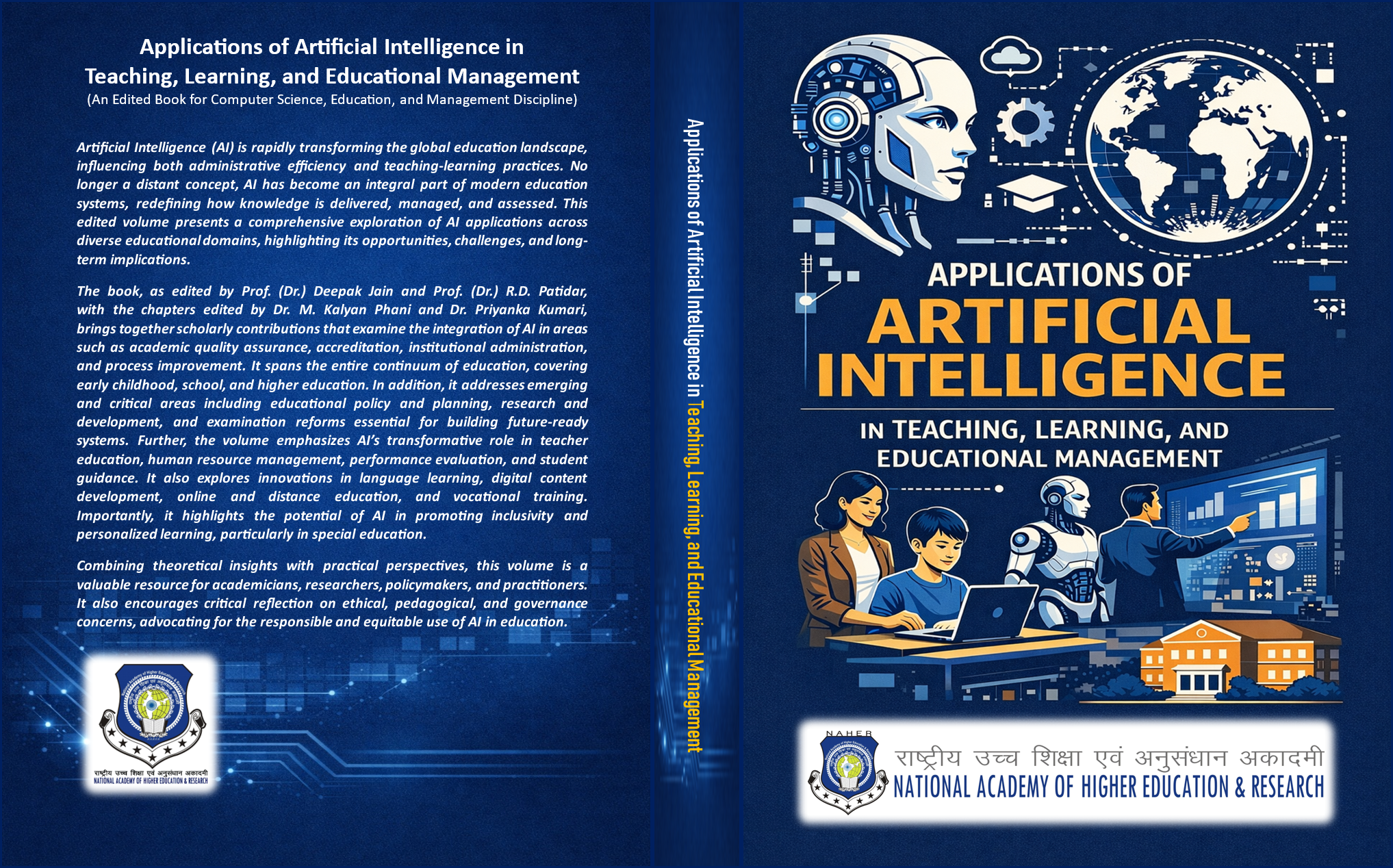
Vocational and skill-based education is central to workforce development, as it equips learners with practical competencies, technical expertise, and employability skills aligned with specific industries. In the context of rapid technological advancement, globalization, and shifting labor market demands, traditional vocational training models face challenges related to scalability, consistency, safety, and alignment with emerging industry needs. Artificial Intelligence (AI) has emerged as a transformative force capable of redefining vocational and skill education by enhancing personalization, efficiency, and relevance.
This chapter explores the role of AI in vocational and skill-based education, highlighting its capacity to deliver adaptive and learner-centered training experiences. AI-powered systems enable personalized learning pathways by analyzing real-time performance data and tailoring instructional content to individual learners’ strengths and gaps. Immersive technologies such as AI-driven virtual and augmented reality simulations provide safe, cost-effective environments for hands-on practice in high-risk or resource-intensive trades. Additionally, AI-based assessment tools offer objective, continuous feedback on skill performance, improving accuracy, safety compliance, and mastery.
The chapter also examines how AI supports curriculum alignment with industry demands through data-driven labor market analysis, ensuring that vocational programs remain current and employment-focused. Beyond technical training, AI facilitates the development of soft skills, professional competencies, and lifelong learning pathways essential for sustained employability in dynamic work environments. While acknowledging challenges related to infrastructure, cost, educator readiness, and ethical considerations, the chapter concludes that AI holds significant promise in bridging the gap between education and industry. By fostering adaptable, skilled, and future-ready professionals, AI has the potential to reshape vocational and skill education as a cornerstone of sustainable economic and workforce development.
References
Artificial intelligence in personalized learning: A global systematic review of current advancements and shaping future opportunities, Social Sciences & Humanities Open, vol. 12, Art. no. 102114, 2025. doi: 10.1016/j.ssaho.2025.102114.
Artificial intelligence teaching and learning in K-12 from 2019 to 2022: A systematic literature review, Computers and Education: Artificial Intelligence, vol. 4, Art. no. 100145, 2023. doi: 10.1016/j.caeai.2023.100145.
Personalized education and artificial intelligence in the United States, China, and India: A systematic review using a Human-In-The-Loop model, Computers and Education: Artificial Intelligence, vol. 3, Art. no. 100068, 2022. doi: 10.1016/j.caeai.2022.100068.
Systematic literature review on opportunities, challenges, and future research recommendations of artificial intelligence in education, Computers and Education: Artificial Intelligence, vol. 4, Art. no. 100118, 2023. doi: 10.1016/j.caeai.2022.100118.
Systematic review of research on artificial intelligence in K-12 education (2017–2022), Computers and Education: Artificial Intelligence, vol. 6, Art. no. 100195, 2024. doi: 10.1016/j.caeai.2023.100195.
A. Green, Artificial intelligence and the changing demand for skills in the labour market, OECD Artificial Intelligence Papers, no. 14, OECD Publishing, Paris, France, Apr. 2024. doi: 10.1787/88684e36-en.
A. Jagathkar and D. Jain, Digitized education: A new social divide between rural and urban India, IARS' International Research Journal, vol. 10, no. 1, 2020. doi: 10.51611/iars.irj.v10i1.2020.115.
A. Jagathkar, Draft National Education Policy 2016: Will it help in achieving education outcomes?, IARS' International Research Journal, vol. 6, no. 2, 2016. doi: 10.51611/iars.irj.v6i2.2016.60.
D. Jain, Don’t kill innovation: Concept towards a new academic world, IARS' International Research Journal, vol. 9, no. 1, 2019. doi: 10.51611/iars.irj.v9i1.2019.98.
H. Agarwal, Artificial intelligence in employee well-being and human resource management, OPJU Business Review, vol. 4, no. 1, 2025. doi: 10.63825/opjubr.2025.4.1.07.
L. F. Ali and S. F. Ali, Digital literacy as a gateway to lifelong learning for underprivileged youth: Insights from a case study, IARS' International Research Journal, vol. 16, no. 1, 2026. doi: 10.51611/iars.irj.v16i1.2026.279.
Ö. Yılmaz, Personalised learning and artificial intelligence in science education: Current state and future perspectives, Educational Technology Quarterly, 2024. doi: 10.55056/etq.744.
P. Agarwal and A. Vij, Assessing the challenges and opportunities of artificial intelligence in Indian education, International Journal for Global Academic & Scientific Research, vol. 3, no. 1, 2024. doi: 10.55938/ijgasr.v3i1.71.
P. Kaushik, Artificial intelligence accelerated transformation in the healthcare industry, Amity Journal of Professional Practices, vol. 3, no. 1, 2023. doi: 10.55054/ajpp.v3i01.630.
P. Kaushik, Congestion articulation control using machine learning technique, Amity Journal of Professional Practices, vol. 3, no. 1, 2023. doi: 10.55054/ajpp.v3i01.631.
P. Kaushik, Role and application of artificial intelligence in business analytics: A critical evaluation, International Journal for Global Academic & Scientific Research, vol. 1, no. 3, pp. 1–11, 2022. doi: 10.55938/ijgasr.v1i3.15.
R. Pant, A. Gehlot, R. Singh, S. Dabral, M. Adnan, and R. Sharma, Impact of artificial intelligence and virtual reality on critical thinking: Investigating the mediating role of cognitive offloading and learning engagement, International Journal for Global Academic & Scientific Research, vol. 5, no. 3, 2026. doi: 10.55938/ijgasr.v5i3.404.
R. Thapar and Pooja, Education 4.0: Revolutionizing learning by transitioning from chalkboards to innovative technology in India, OPJU Business Review, vol. 4, no. 1, 2025. doi: 10.63825/opjubr.2025.4.1.03.
S. Bankins, X. Hu, and Y. Yuan, Artificial intelligence, workers, and future of work skills, Current Opinion in Psychology, vol. 58, Art. no. 101828, 2024. doi: 10.1016/j.copsyc.2024.101828.
S. Bankins, X. Hu, and Y. Yuan, Artificial intelligence, workers, and future of work skills, Current Opinion in Psychology, vol. 58, Art. no. 101828, 2024. doi: 10.1016/j.copsyc.2024.101828.
S. P. S. Rathore, Analysing the efficacy of training strategies in enhancing productivity and advancement in profession: Theoretical analysis in Indian context, International Journal for Global Academic & Scientific Research, vol. 2, no. 2, pp. 38–50, 2023. doi: 10.55938/ijgasr.v2i2.49.
S. R. Tahir, The symbiotic scholar: A framework for integrating artificial intelligence in academic writing while upholding ethical integrity, IARS' International Research Journal, vol. 15, no. 2, 2025. doi: 10.51611/iars.irj.v15i2.2025.266.
Downloads

Downloads
Published
Issue
Section
License
Copyright (c) 2025 R. D. Patidar, Vanshika Jain, Jitendra Jha

This work is licensed under a Creative Commons Attribution 4.0 International License.
Author(s) hold complete right on the content of this article.