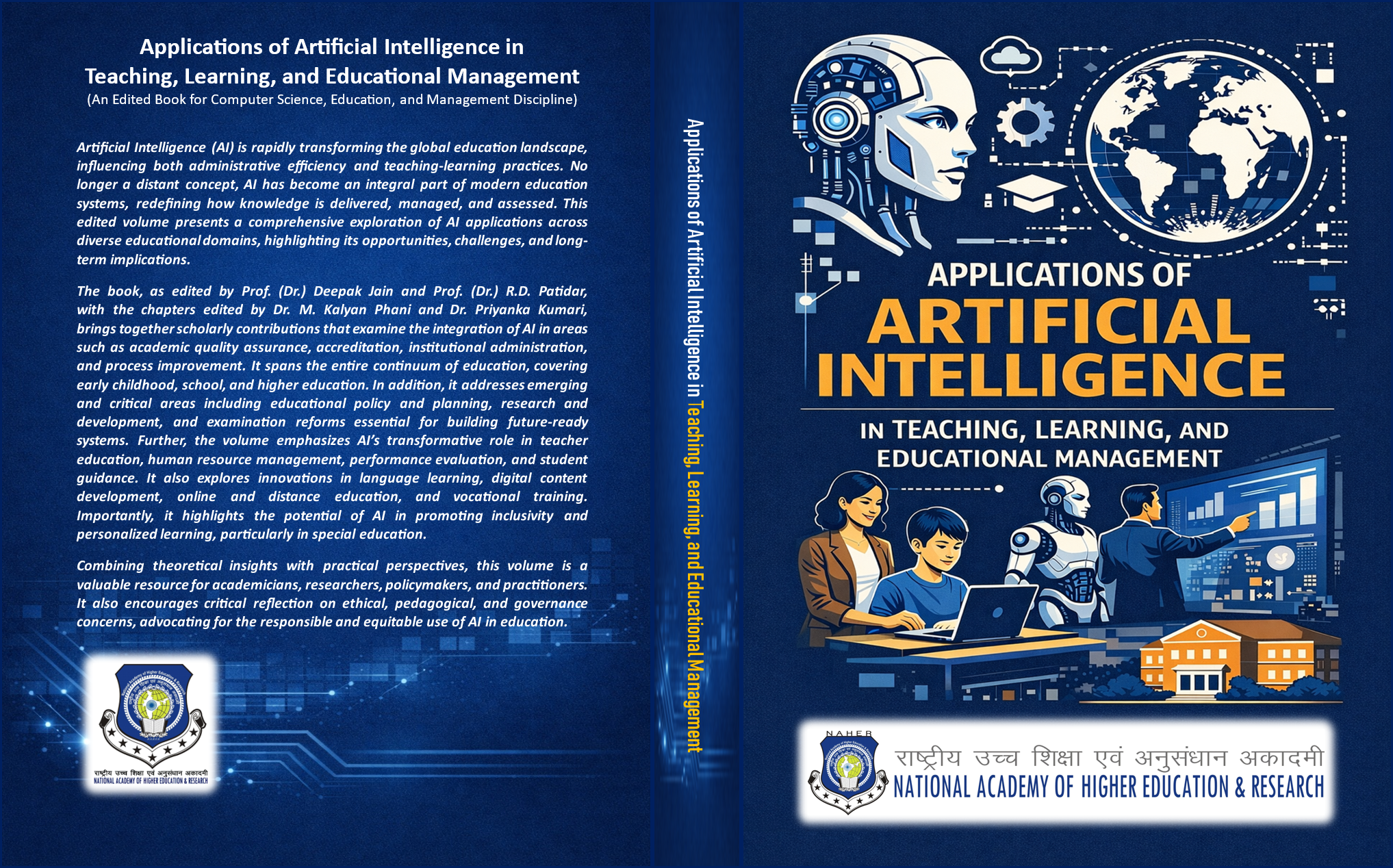
Artificial Intelligence for Special Education
DOI:
https://doi.org/10.62431/2ser0b84Keywords:
Special education, Learner diversity, Intellectual disabilities, Attention Deficit Hyperactivity Disorder (ADHD), Autism Spectrum Disorder (ASD), Multimodal learning systems, AI-driven social robotsAbstract
Special education is inherently complex, requiring highly individualized, adaptive, and inclusive approaches to address the diverse learning needs of students with disabilities. Traditional special education relies heavily on human expertise, empathy, and collaboration among educators and specialists, yet it often faces challenges such as limited resources, high student-to-teacher ratios, administrative burdens, and the wide variability of learner needs. In this context, Artificial Intelligence (AI) has emerged as a transformative technology with significant potential to enhance special education practices. This chapter examines the role of AI in supporting learners with special needs by enabling personalized learning pathways, improving accessibility, facilitating early identification and intervention, and assisting educators through data-driven insights and automation of routine tasks. AI technologies—including machine learning, natural language processing, and computer vision—offer adaptive instructional support, assistive communication tools, and real-time monitoring that align closely with the core demands of special education. At the same time, the chapter critically addresses ethical, social, and pedagogical concerns related to data privacy, bias, transparency, and the risk of diminishing human-centered care. Emphasizing that AI should complement rather than replace educators and caregivers, the chapter situates AI within a human-centered and inclusive framework. By exploring both opportunities and challenges, this chapter highlights how responsible integration of AI can contribute to more equitable, effective, and inclusive special education systems, empowering learners with disabilities to reach their full academic, social, and developmental potential.
References
Harkins-Brown, A. R., Carling, L. Z., & Peloff, D. C. (2025). Artificial Intelligence in Special Education. Encyclopedia. https://encyclopedia.pub/entry/57700
Koranteng, U. (2025). AI and Assistive Technology in Special Education: Transforming Learning Access for Students with Disabilities. Asian Journal of Education and Social Studies, 51(9), 240–252.
Mandal, S. (2024). Impact of Artificial Intelligence in Special Education: A Systematic Review. Redshine Archive, 12(11).
Devadas, R. S. (2025). AI Augmented Education for Children with Special Needs: A Scholarly Perspective. World Journal of Advanced Engineering Technology and Sciences, 15(3), 2000–2008.
Kumari, R. K. (2024). Artificial Intelligence in Special Education: Enhancing Learning Outcomes for Students With Disabilities. Transforming Special Education Through Artificial Intelligence, 79–111.
Farooq, S. (2023). Educational Interventions and Future Trends of AI/ML – Game-Based Learning, Cognition, Special Ed. Journal of Student Research.
Rehman, A. (2024). AI for Inclusive Education: Supporting Learners with Disabilities and Special Needs. AIJE, Vol. ?.
Artificial intelligence in education. (n.d.). In Wikipedia.
Intelligent tutoring system. (n.d.). In Wikipedia.
Mehta, S. (2025). Education Policy and Industrial Development in India. jconsortium.com.
Yadav, G. (2023). A Comparative Study of Intelligent Online e-Learning Systems. Curie (researth.iars.info).
Role of Artificial Intelligence in Education. (2024). IJARSCT.
Artificial Intelligence in Special Education Theory and Practice. (n.d.). IGI Global.
Marino, M. T., Vasquez, E., Dieker, L., Basham, J., & Blackorby, J. (2023). The Future of Artificial Intelligence in Special Education Technology. Journal of Special Education Technology.
Enhancing Special Education with AI: Opportunities and Ethical Considerations. (2025). Multidisciplinary Sciences Journal.
A Review of Assistive Technology in Special Education. (2025). MDPI Education Journal.
Artificial Intelligence in Special Education. (2024). ResearchGate literature overview.
AI-Powered Early Detection and Intervention for Learning Disabilities. (2026). Eurekamag Lecture Notes in Networks and Systems.
Fitas, R. (2025). Inclusive Education with AI: Supporting Special Needs and Tackling Language Barriers. AI and Ethics (Springer).
Porayska-Pomsta, K., Holmes, W., & Nemorin, S. (2024). The Ethics of AI in Education. arXiv.
Bulut, O., Beiting-Parrish, M., et al. (2024). The Rise of Artificial Intelligence in Educational Measurement. arXiv.
Lee, G.-G., et al. (2023). Multimodality of AI for Education: Towards Artificial General Intelligence. arXiv.
Yang, C. & Taele, P. (2025). AI for Accessible Education: Personalized Audio-Based Learning for Blind Students. arXiv.
Downloads

Downloads
Published
Issue
Section
License
Copyright (c) 2025 Amit Paras, Geetanjali Sachdeva

This work is licensed under a Creative Commons Attribution 4.0 International License.
Author(s) hold complete right on the content of this article.