Artificial Intelligence for Higher Education
DOI:
https://doi.org/10.62431/7dsne293Keywords:
Optimization, Credential-awarding, Collaboration, Pedagogical practice, Integration, Sophisticated, Formative evaluation, Personalized interventionsAbstract
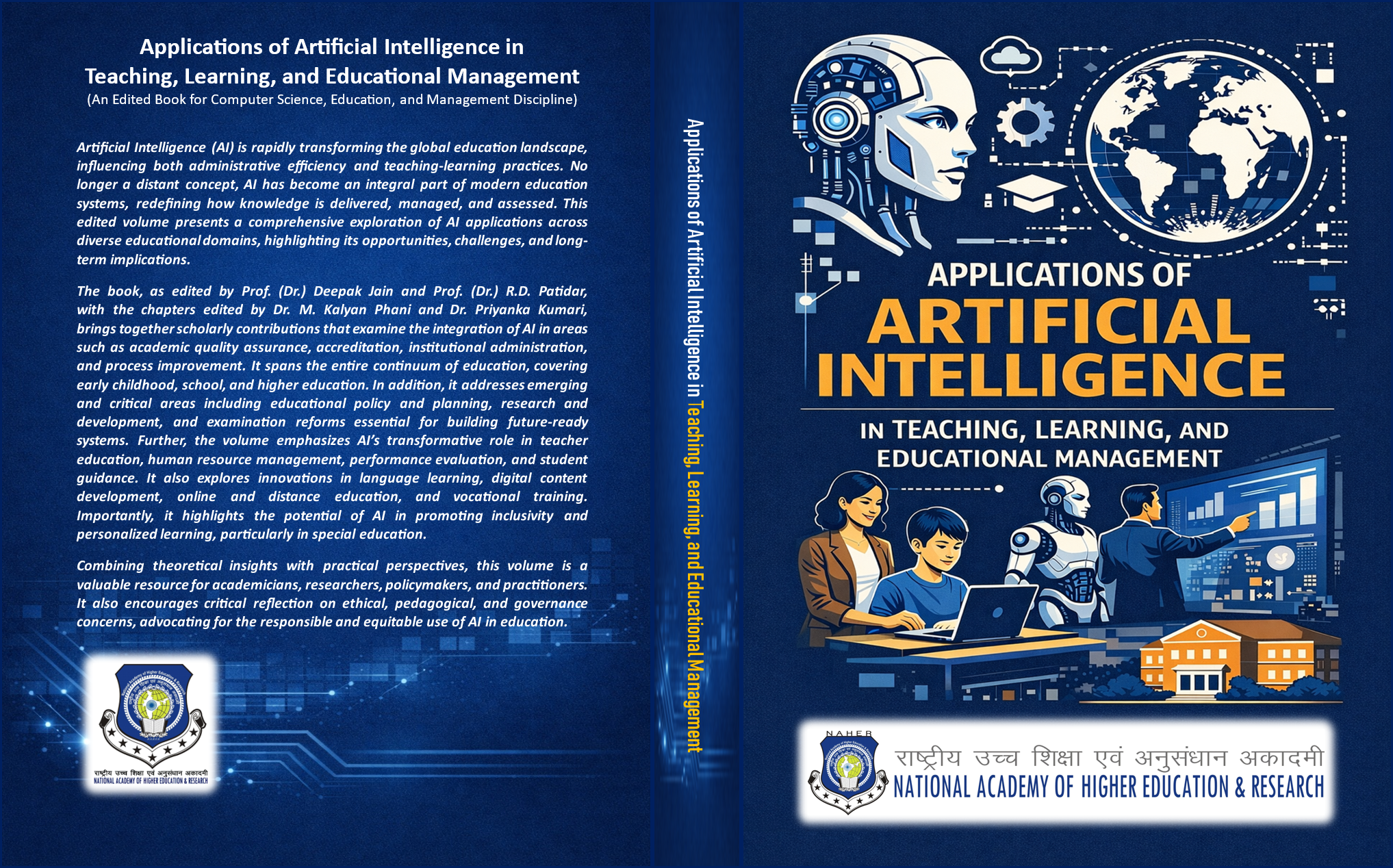
Artificial Intelligence (AI) is increasingly recognized as a transformative force reshaping higher education in response to growing complexity, diversity, and global competitiveness. As universities and colleges navigate challenges related to massification, digital transformation, learner diversity, and demands for accountability, AI offers powerful tools to enhance academic quality, institutional efficiency, and student success. This chapter examines the multifaceted role of AI in higher education, highlighting its applications across teaching and learning, assessment and evaluation, student support and retention, research and knowledge creation, and institutional management and governance.
AI-driven systems enable personalized, learner-centered education through adaptive learning platforms, intelligent tutoring systems, and automated feedback mechanisms, supporting inclusive and flexible learning pathways. In assessment, AI enhances consistency, scalability, and formative feedback while enabling innovative evaluation of complex learning outcomes. Predictive analytics and intelligent advising systems support proactive, personalized student support, improving retention and equity. In research, AI accelerates data analysis, literature synthesis, interdisciplinary collaboration, and knowledge discovery, expanding the scope and impact of scholarly inquiry. At the institutional level, AI strengthens strategic planning, resource optimization, quality assurance, and evidence-based governance.
The chapter also critically examines ethical, equity, and governance considerations associated with AI adoption, including data privacy, algorithmic bias, transparency, academic freedom, and human oversight. Emphasizing a human-centered and responsible approach, it argues that AI should augment rather than replace human judgment and academic values. By situating AI within the broader mission of higher education, the chapter demonstrates how thoughtfully governed AI integration can enhance inclusivity, resilience, and sustainability, preparing institutions and learners for an increasingly digital and interconnected future.
References
Popenici, S. A. D. & Kerr, S. (2017). Exploring the impact of artificial intelligence on teaching and learning in higher education. Research and Practice in Technology Enhanced Learning.
Zawacki-Richter, O., Marín, V. I., Bond, M., & Gouverneur, F. (2019). Systematic review of research on artificial intelligence applications in higher education—Where are the educators? International Journal of Educational Technology in Higher Education.
Crompton, H. & Burke, D. (2023). Artificial intelligence in higher education: The state of the field. International Journal of Educational Technology in Higher Education.
Ouyang, F., Zheng, L. & Jiao, P. (2022). Artificial intelligence in online higher education—A systematic review of empirical research (2011–2020). Education and Information Technologies.
Ke Zhang & Ayse Begum Aslan (2021). AI technologies for education: Recent research & future directions. Computers and Education: Artificial Intelligence.
Artificial Intelligence and Education 4.0: Revolutionizing Learning in India — Thapar, R. & Pooja, R. (2025). Education 4.0. JConsortium.
Geetharani, S. (2019). Pattern Recognition and Machine Learning. JConsortium Scholar.
Artificial Intelligence Accelerated Transformation in the Healthcare Industry — Kaushik, P. (2023). Amity Journal of Professional Practices. JConsortium.
Mahajan, P. (2025). What is Ethical: Human-Driven AI in Higher Education (HD-AIHED). arXiv preprint.
Sajja, R., Sermet, Y., et al. (2023). AI-Enabled Intelligent Assistant for Personalized and Adaptive Learning in Higher Education. arXiv preprint.
Chan, C. K. Y. & Tsi, L. H. Y. (2023). The AI Revolution in Education: Will AI Replace or Assist Teachers in Higher Education? arXiv preprint.
McDonald, N., Johri, A., Ali, A. & Hingle, A. (2024). Generative AI in Higher Education: Institutional Policies and Guidelines. arXiv preprint.
Ogunleye, B., Zakariyyah, K. I., et al. (2024). A Systematic Review of Generative AI for Teaching and Learning Practice. arXiv preprint.
Artificial Intelligence in Higher Education: A Literature Snapshot. Boratkar, J. V. & Sambhe, R. U. (2024). Int. J. Sci. Res. Sci. Eng. Technol.
A Systematic Review of AI in Higher Education Institutions (HEIs) (2025). MDPI Educational Sciences.
Discourses of Artificial Intelligence in Higher Education: A Critical Literature Review. Bearman, M., Ryan, J. & Ajjawi, R. (2022). Higher Education.
Downloads

Downloads
Published
Issue
Section
License
Copyright (c) 2025 R. D. Patidar, Vinita Bankira

This work is licensed under a Creative Commons Attribution 4.0 International License.
Author(s) hold complete right on the content of this article.