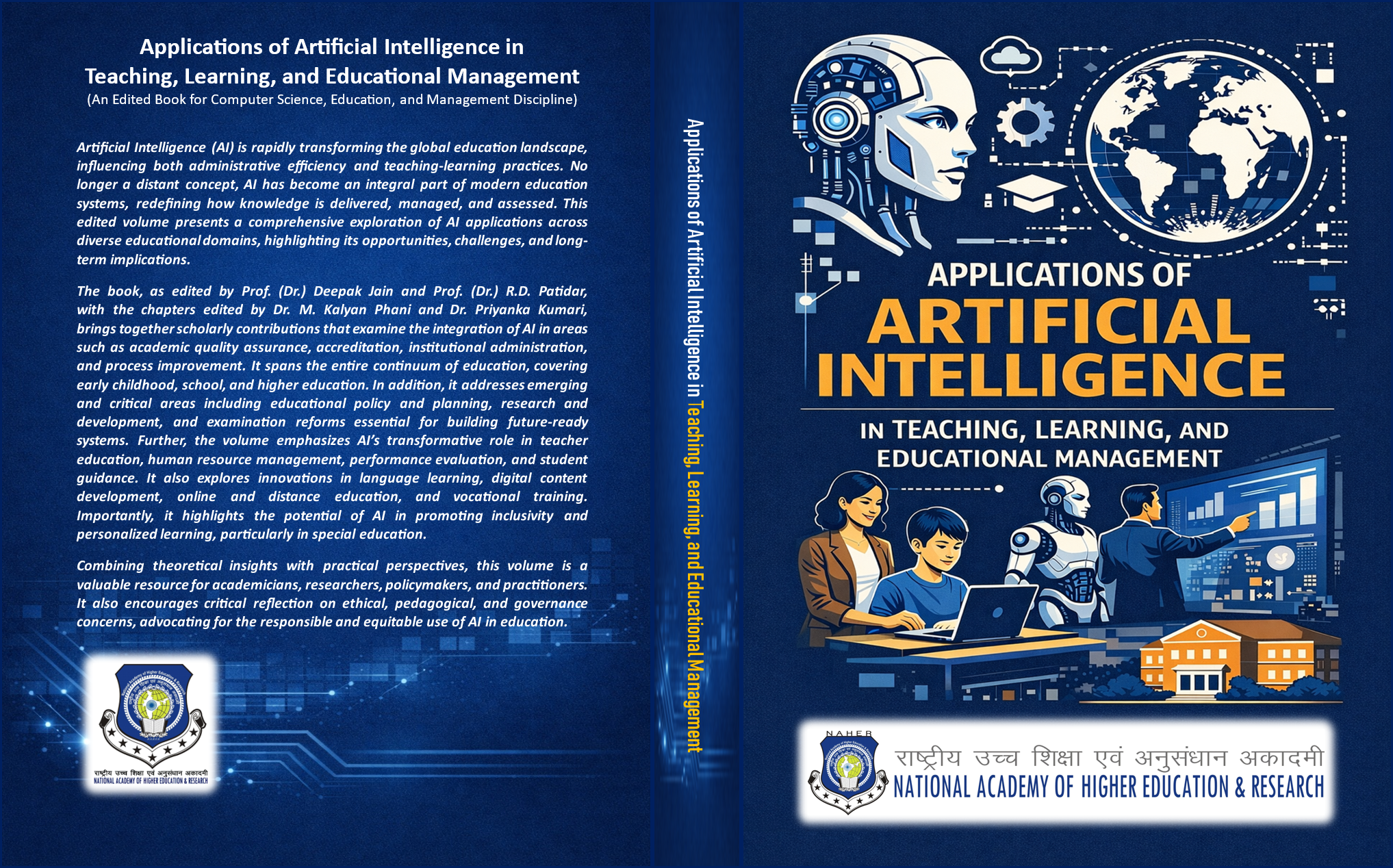
Artificial Intelligence for Academic Process Improvement
DOI:
https://doi.org/10.62431/aganjf85Keywords:
Conceptual Foundations, Rationale, Traditional Improvement, Globalization, Inconsistent, Continuous refinement, Retrospective analysisAbstract
The rapid transformation of higher education systems has intensified the need for systematic, data-driven, and learner-centered academic process improvement. Academic institutions are increasingly required to enhance teaching quality, learning outcomes, assessment practices, and student support mechanisms while simultaneously addressing challenges related to scale, diversity, accountability, and resource constraints. Within this evolving context, Artificial Intelligence (AI) has emerged as a powerful enabler of academic process improvement, offering advanced analytical capabilities, adaptive learning solutions, and intelligent decision-support systems.
This chapter explores the role of Artificial Intelligence in improving core academic processes, including curriculum design, instructional delivery, assessment and evaluation, academic advising, learning analytics, faculty development, and quality assurance. It examines how AI-driven technologies—such as machine learning algorithms, predictive analytics, adaptive learning platforms, and intelligent tutoring systems—support continuous improvement by transforming academic data into actionable insights. Through real-time monitoring and predictive modeling, AI enables institutions to move from retrospective evaluation to proactive and preventive academic management.
The chapter emphasizes a human-centered approach to AI adoption, recognizing that education is fundamentally a value-driven and relational enterprise. While AI enhances efficiency, personalization, and scalability, human judgment, pedagogical expertise, and ethical oversight remain central to academic decision-making. The discussion highlights the importance of aligning AI implementation with institutional mission, academic freedom, inclusivity, and equity.
In addition, the chapter critically examines challenges associated with AI adoption, including data quality limitations, algorithmic bias, privacy concerns, infrastructure readiness, and faculty engagement. Policy and governance considerations are addressed, underscoring the need for transparent frameworks, ethical guidelines, and capacity-building initiatives to ensure responsible and sustainable use of AI in academic environments.
By integrating technological innovation with pedagogical integrity and institutional governance, this chapter provides a comprehensive framework for leveraging Artificial Intelligence as a strategic tool for academic process improvement. It offers valuable insights for educators, academic administrators, policymakers, and researchers seeking to enhance educational quality, learner success, and institutional resilience in a rapidly changing higher education landscape.
References
Thapar, R., & Pooja. (2025). Education 4.0: Revolutionizing Learning by Transitioning from Chalkboards to Innovative Technology in India. OPJU Business Review.
Selvakumari, S. (2019). Robotic Intelligence. Scholar: National School of Leadership.
Geetharani, S. (2019). Pattern Recognition and Machine Learning. Scholar: National School of Leadership.
Madhavi, L. K., Santhosh, S., & Thampi, V. (2022). Digitization of Education and its Socio-Economic Impacts. Amity Journal of Professional Practices.
Yadav, R. S. (2022). A Case Study of Linear Regression Analysis. CURIE.
Yadav, G. (2023). A Comparative Study of Intelligent Online e-Learning. CURIE.
Rustagi, M., & Goel, N. (2022). Predictive Analytics: Advantages and Applications. IARS’ International Research Journal.
Chen, L., Chen, P., & Lin, Z. (2020). Artificial intelligence in education: A review. IEEE Access.
Holmes, W., Bialik, M., & Fadel, C. (2019). Artificial Intelligence in Education: Promises and Implications for Teaching and Learning. Center for Curriculum Redesign.
Baker, R. S. J. d., & Yacef, K. (2009). The state of educational data mining in 2009: A review and future visions. Journal of Educational Data Mining.
Siemens, G. (2005). Connectivism: A learning theory for the digital age. International Journal of Instructional Technology and Distance Learning.
Nguyen, A., Ngo, H. N., Hong, Y., Dang, B., & Nguyen, B.-P. (2023). Ethical principles for artificial intelligence in education. Education and Information Technologies.
Cukurova, M. (2024). The interplay of learning, analytics, and AI in education: A vision for hybrid intelligence. ArXiv.
Furze, L., Perkins, M., Roe, J., & MacVaugh, J. (2024). The AI Assessment Scale (AIAS) in action. ArXiv.
Baillifard, A., Gabella, M., & Lavenex, P. B. (2023). Implementing learning principles with a personal AI tutor: case study. ArXiv.
Latif, E., Mai, G., Wu, X., et al. (2023). AGI: Artificial General Intelligence for Education. ArXiv.
Vieriu, A. M., & Petrea, G. (2025). The impact of AI on students’ academic development. Education Sciences.
Chang, C. I., Choi, W. C., & Choi, I. C. (2024). Systematic literature review of AIGC in programming courses. In Proceedings of the 7th International Conference on Big Data and Education.
Holmes, W. & Tuomi, I. (2022). Teachers’ trust in AI-powered educational technology and professional development. British Journal of Educational Technology.
Azeem, S., & Abbas, M. (2025). Personality correlates of academic use of generative intelligent systems. Education and Information Technologies.
Cotton, D., Cotton, P., & Shipway, R. (2023). Chatting and cheating: Ensuring academic integrity in the era of ChatGPT. Innovations in Education and Teaching International.
Baker, R. S. (n.d.). Educational data mining and learning analytics perspectives. University education research archive.
Isotani, S. (n.d.). AI in Education and gamification research profiles. University of São Paulo faculty.
Adaptive learning technologies as a strategy for personalized learning enhancement. (n.d.). Adaptive Learning.
Intelligent tutoring systems in educational contexts. (n.d.). Intelligent Tutoring System.
Abiodun, O. I., et al. (2019). Comprehensive review of artificial neural network applications to pattern recognition. Journal of Machine Learning Techniques.
Luckin, R., Holmes, W., Griffiths, M., & Forcier, L. B. (2016). Intelligence Unleashed: An Argument for AI in Education. Pearson Education.
Dastbaz, M., & Abawajy, J. H. (2017). Smart education systems: A vision for the future of higher education. Journal of Educational Technology & Society.
Guszcza, J., & Tandy, P. (2019). AI and education: A new frontier. PwC research report.
Shute, V. J., & Zapata-Rivera, D. (2019). Measuring and supporting student learning through educational technology. Journal of Educational Psychology.
Downloads

Downloads
Published
Issue
Section
License
Copyright (c) 2025 M. Kalyan Phani, Deepak Jain, Kumari Bharti

This work is licensed under a Creative Commons Attribution 4.0 International License.
Author(s) hold complete right on the content of this article.