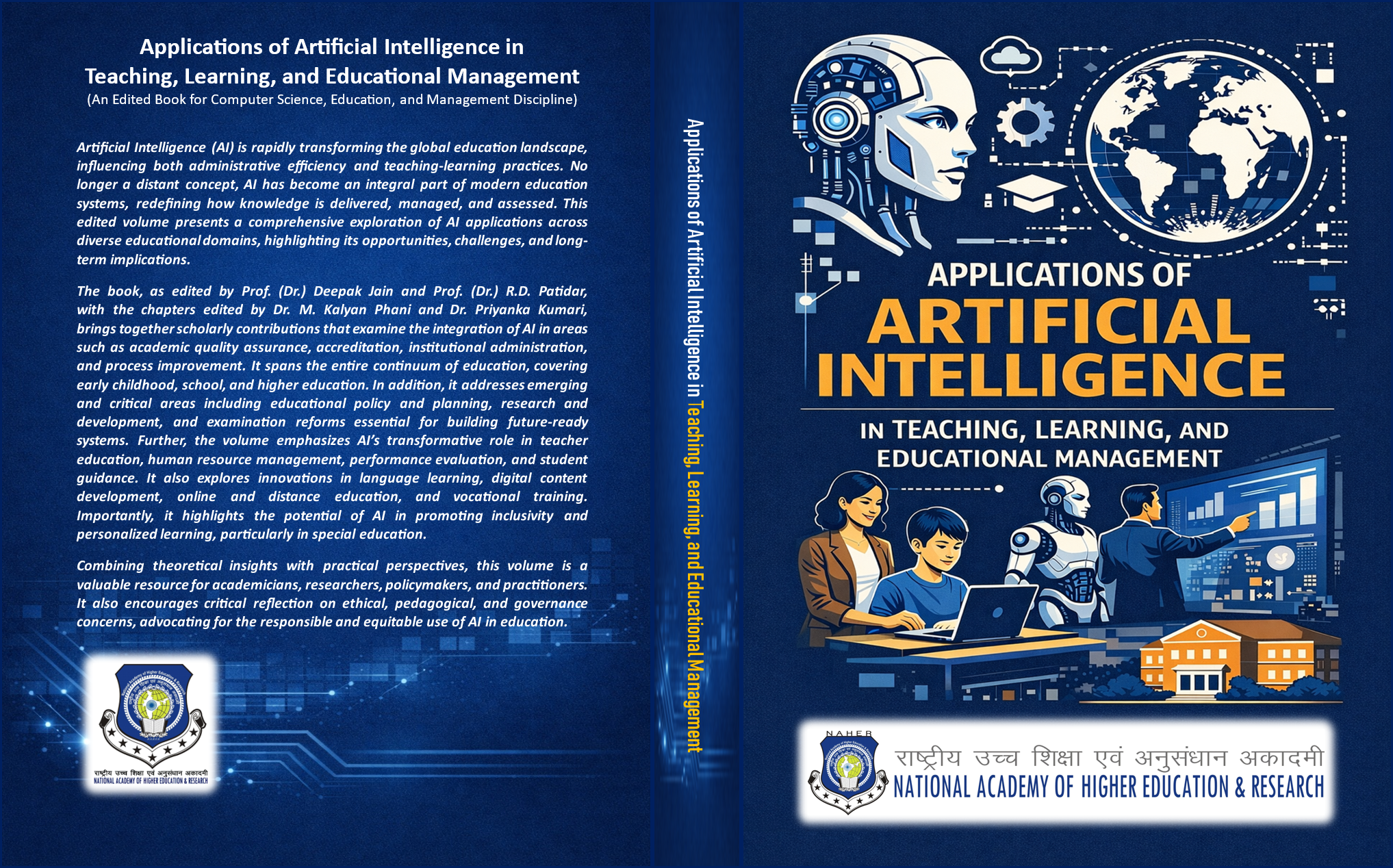
Artificial Intelligence for Examination Process Improvement
DOI:
https://doi.org/10.62431/emd51006Keywords:
Educational pathways, Inefficiencies, Diversification, Inconsistencies, Human intelligence, Credibility, ExplainabilityAbstract
The examination process plays a pivotal role in educational systems by evaluating learner achievement, certifying competencies, and ensuring institutional accountability. However, conventional examination systems face growing challenges related to scalability, efficiency, fairness, security, and limited pedagogical value, particularly in the context of expanding student populations and digital education environments. Delays in evaluation, inconsistencies in grading, susceptibility to malpractice, standardized assessment models, and minimal feedback mechanisms have raised concerns about the credibility and relevance of traditional examinations.
Artificial Intelligence (AI) has emerged as a transformative force capable of addressing these limitations and reimagining examination processes in a more intelligent, adaptive, and learner-centered manner. This chapter examines the role of AI in improving the examination lifecycle, encompassing intelligent question paper design, adaptive and personalized assessments, secure examination administration, automated evaluation, and analytics-driven feedback. By leveraging machine learning, natural language processing, computer vision, and data analytics, AI enhances efficiency, objectivity, scalability, and assessment validity while enabling faster result processing and meaningful diagnostic feedback.
The chapter also critically explores the ethical, legal, and pedagogical implications of AI-driven examinations, including concerns related to data privacy, algorithmic bias, transparency, and human oversight. Emphasizing a balanced human–AI partnership, it highlights the crucial roles of educators and institutions in governance, moderation, and ethical implementation. The chapter concludes by outlining future directions toward competency-based, continuous, and multimodal assessment models. Overall, it positions AI-enabled examination systems as key enablers of fairer, more credible, and future-ready educational assessment practices.
References
González-Calatayud, V., Prendes-Espinosa, P., & Roig-Vila, R. Artificial Intelligence for Student Assessment: A Systematic Review. Appl. Sci. 11(12) (2021).
Isley, C., Gilbert, J., Kassos, E., Kocher, M., Nie, A., Brunskill, E., Domingue, B., Hofman, J., Legewie, J., Svoronos, T., & Tuminelli, C. Assessing the Quality of AI-Generated Exams: A Large-Scale Field Study. arXiv (2025).
Kortemeyer, G., & Nöhl, J. Assessing Confidence in AI-Assisted Grading of Physics Exams through Psychometrics: An Exploratory Study. arXiv (2024).
Cvengros, J., & Kortemeyer, G. Assisting the Grading of a Handwritten General Chemistry Exam with Artificial Intelligence. arXiv (2025).
Yadav, B. R. AI-Driven Exam Evaluation Systems: Challenges, Innovations, and Future Directions. Int. J. Electron. Autom. (2024).
Barba, L. A., & Stegner, L. The Conversational Exam: A Scalable Assessment Design for the AI Era. arXiv (2026).
Biju, N., Abdelrasheed, N. S. G., Bakiyeva, K., et al. AI-Assisted Language Assessment vs. Paper Format. Lang Test Asia 14, 45 (2024).
Design of an Adaptive Examination System Based on Artificial Intelligence Recognition Model. Mech. Syst. Signal Process. 142 (2020).
Automatic Item Generation. Frontiers in Psychology. (Automatic test item generation theory).
Benazer, S. S., Ramamoorthy, S. K., & Kamali, S. M. An AI-Based Intelligent Exam Proctoring System for Secure and Fair Online Assessments. J. Adv. Res. AI & Its Appl. – (2024).
PeerJ Automated Evaluation Systems to Enhance Exam Quality and Reduce Test Anxiety. PeerJ Computer Science (2025).
Peters, M., & Angelov, D. Redefining Assessment Tasks to Promote Students’ Creativity and Integrity in the Age of Generative AI. Int. J. Educ. Integr. (2025).
Automatic Grading, Feedback, and AI in Exams — UNESCO AI & Education Ethics Recommendation. (Discussed within systematic review in Reference 1).
JS International Journal of Multidisciplinary Research — General research journal from jconsortium.com.
Pattern Recognition and Machine Learning, Geetharani (Scholar: National School of Leadership). (AI foundational background).
Robotic Intelligence, Selvakumari (Scholar: National School of Leadership). (Robotics & AI overview).
Thapar, R., & Pooja. Education 4.0: Revolutionizing Learning by Transitioning from Chalkboards to Innovative Technology in India. OPJU Bus. Rev. (2025).
Khatoon, U. T., & Madkhali, R. A. A Comprehensive Examination of Artificial Intelligence in the Field of Education. Indian J. Comput. Sci. 8(6) (2023).
Evaluating AI-Generated Examination Papers in Periodontology: Comparative Study with Human-Designed Counterparts. BMC Med. Educ. (2025).
Landers, R. N. Research on AI, Engagement, and Algorithmic Bias in Educational Assessment. (Wikipedia overview of relevant themes).
UNESCO. Elaboration of a Recommendation on the Ethics of Artificial Intelligence. (Referenced within González-Calatayud et al. 2021).
United Nations Transforming Our World: The 2030 Agenda for Sustainable Development. (Referenced within González-Calatayud et al. 2021).
Bloom, B. S. Taxonomy of Educational Objectives: The Classification of Educational Goals. Longmans, Green (classic foundation for adaptive and cognitive level assessment).
Russell, S. & Norvig, P. Artificial Intelligence: A Modern Approach. Prentice Hall (core AI textbook relevant to adaptive learning and assessment).
Bormuth, J. On a Theory of Achievement Test Items. University of Chicago Press (foundational work referenced in automatic item generation).
Downloads

Downloads
Published
Issue
Section
License
Copyright (c) 2025 Girish Mishra, Ishika Sachdeva

This work is licensed under a Creative Commons Attribution 4.0 International License.
Author(s) hold complete right on the content of this article.