Artificial Intelligence for Educational Research
DOI:
https://doi.org/10.62431/hwpktk06Keywords:
Educational research, Socio-cultural, Analytical capabilities, Systematic knowledge, Interpretivist, Speech recognition, Enduring relevanceAbstract
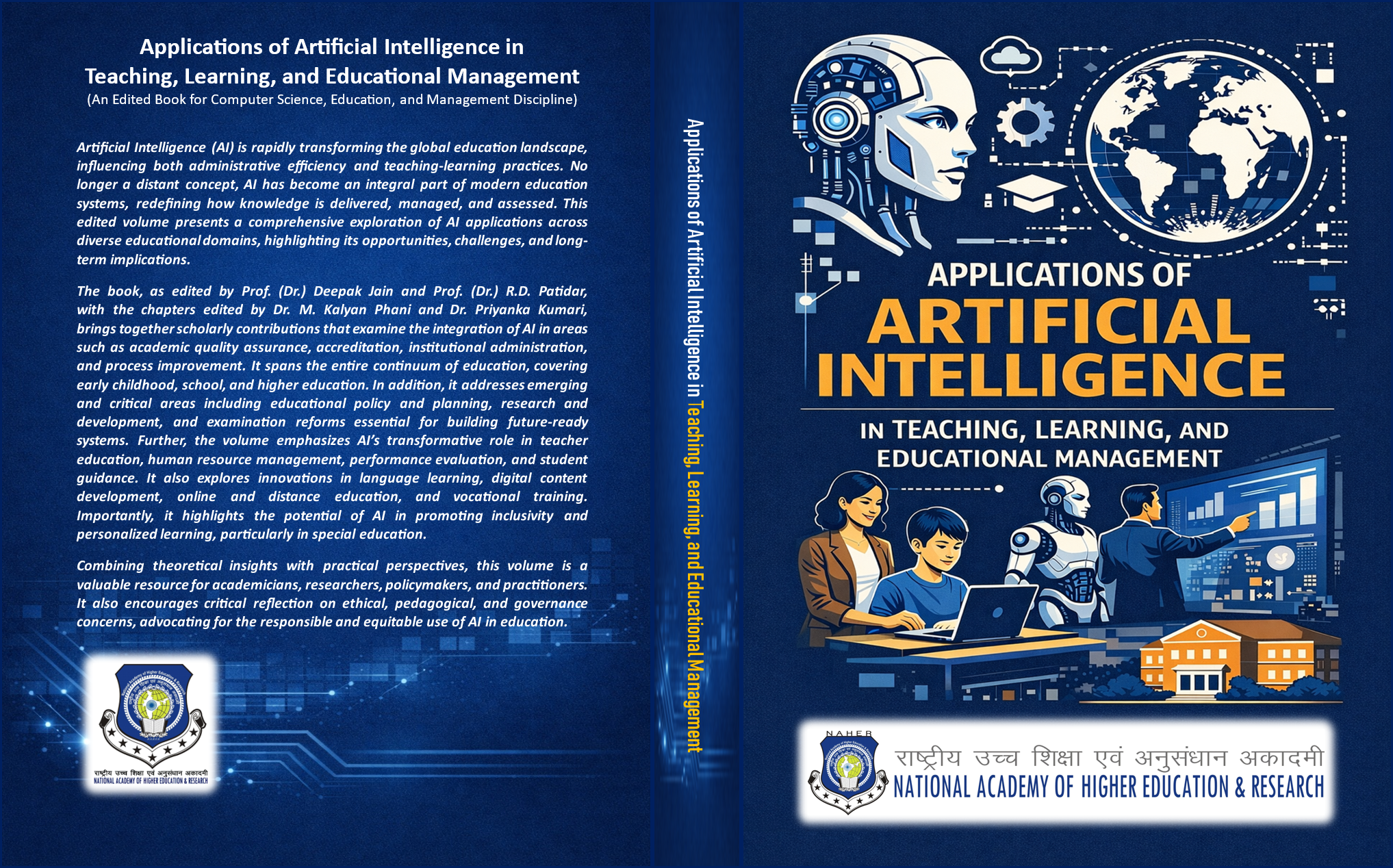
Educational research plays a vital role in understanding learning processes, teaching practices, institutional functioning, and policy effectiveness. However, the rapid digitalization of education has generated vast, complex, and heterogeneous datasets that challenge the capacity of traditional research methods. Artificial Intelligence (AI) has emerged as a powerful methodological enabler that expands the analytical scope, efficiency, and depth of educational research without displacing its theoretical and human-centered foundations. This chapter examines the role of AI in redefining educational research across the entire research lifecycle, including research design, data collection, data management, analysis, mixed-methods integration, and policy-oriented inquiry. It highlights how AI techniques such as machine learning, natural language processing, learning analytics, and predictive modeling support the systematic analysis of large-scale quantitative, qualitative, and multimodal data, enabling the identification of complex patterns, longitudinal trends, and actionable insights. The chapter emphasizes that AI functions as an augmentative research tool, enhancing methodological rigor, transparency, and scalability while remaining dependent on human judgment, theoretical grounding, and contextual interpretation. Ethical considerations—such as data privacy, informed consent, algorithmic bias, transparency, and equity—are critically examined to underscore the responsibilities associated with AI-driven research. By situating AI within established epistemological paradigms and educational values, the chapter argues that AI represents an evolutionary advancement rather than a departure from traditional educational research. Ultimately, the integration of AI offers significant potential to strengthen evidence-based practice and policy, provided it is applied critically, ethically, and in alignment with the humanistic purposes of education in the digital age.
References
Altundal, B. (2024). A Review of Artificial Intelligence and Its Use in Education. Artificial Intelligence in Educational Research, 1(1), 28–38.
Zawacki-Richter, O., Marín, V. I., Bond, M. et al. (2019). Systematic review of research on artificial intelligence applications in higher education – where are the educators? Int J Educ Technol High Educ, 16, 39.
Garzón, J. (2025). Systematic Review of Artificial Intelligence in Education. Multimodal Learning Environments, 9(8), 84.
Wang, S. (2024). Artificial intelligence in education: A systematic literature review. Computers & Education: Artificial Intelligence.
Cukurova, M. (2024). The Interplay of Learning, Analytics, and Artificial Intelligence in Education: A Vision for Hybrid Intelligence. arXiv preprint.
Bulut, O., Beiting-Parrish, M., Casabianca, J. M., et al. (2024). The Rise of Artificial Intelligence in Educational Measurement: Opportunities and Ethical Challenges. arXiv preprint.
Holstein, K., Doroudi, S. (2021). Equity and Artificial Intelligence in Education: Will “AIEd” Amplify or Alleviate Inequities in Education? arXiv preprint.
Russell, S., & Norvig, P. (2020). Artificial Intelligence: A Modern Approach (4th ed.). Prentice Hall.
Farahani, M. S. (2024). Artificial Intelligence in education: A comprehensive study. FES Journal.
Fitria, T. N. (2021). Artificial Intelligence in Education: Using AI Tools for Teaching and Learning Process. Proceedings Seminar Nasional.
Artificial Intelligence in Education (peer-reviewed journal). Emerald Publishing.
Adaptive learning systems. (2026). Wikipedia Entry on Adaptive Learning.
Geetharani, S. (2019). Pattern Recognition and Machine Learning. Scholar: National School of Leadership.
Thapar, R., & Pooja. (2025). Education 4.0: Revolutionizing Learning by Transitioning from Chalkboards to Innovative Technology in India. OPJU Business Review.
Artificial Intelligence and the Future of Teaching and Learning: Insights and Recommendations. U.S. Department of Education (2023).
Crawford, K. (2021). Atlas of AI: Power, Politics, and the Planetary Costs of Artificial Intelligence. Yale University Press.
Discourses of artificial intelligence in higher education: a critical literature review (Bearman, Ryan & Ajjawi, 2023).
Nuridayanti, N., Tjalla, A., & Soeprijanto, S. (2024). Systematic Literature Review: The Role of AI in Educational Transformation in the Digital Era. EDUTECH Journal.
Russell, S. J., & Norvig, P. (2020). Artificial Intelligence: A Modern Approach. Prentice Hall.
Winston, P. H. (1992). Artificial Intelligence. Addison-Wesley.
Systematic review of research on artificial intelligence in K-12 education (2017–2022). Computers & Education: Artificial Intelligence.
Holstein, K., & Doroudi, S. (2021). Equity and Artificial Intelligence in Education. (Equity lens on AIEd).
Downloads

Downloads
Published
Issue
Section
License
Copyright (c) 2025 Mahesh Bhiwapurkar, Parikshit Layek

This work is licensed under a Creative Commons Attribution 4.0 International License.
Author(s) hold complete right on the content of this article.